Department of Materials and Production
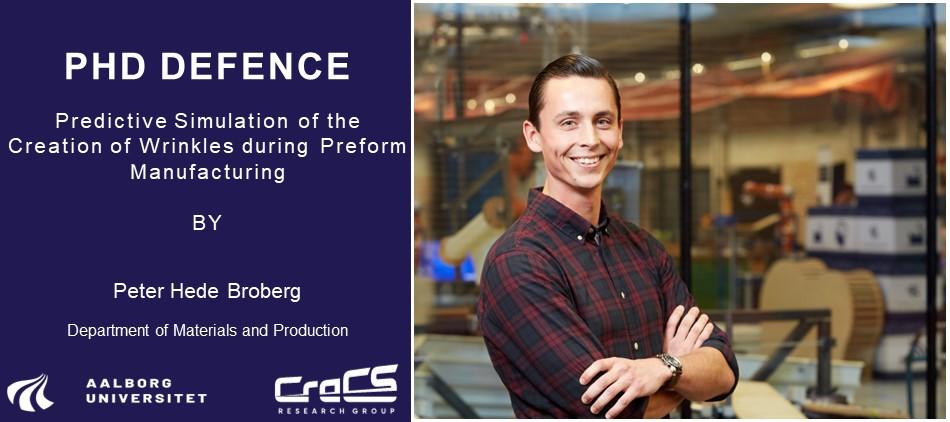
PhD Defence by Peter Hede Broberg
Department of Materials and Production
Fibigerstræde 16 - room 1.201 Or virtual by MS Teams
09.02.2024 10:00 - 13:00

English

Hybrid
Department of Materials and Production
Fibigerstræde 16 - room 1.201 Or virtual by MS Teams
09.02.2024 10:00 - 13:00
English
Hybrid
Department of Materials and Production
PhD Defence by Peter Hede Broberg
Department of Materials and Production
Fibigerstræde 16 - room 1.201 Or virtual by MS Teams
09.02.2024 10:00 - 13:00
English
Hybrid
Department of Materials and Production
Fibigerstræde 16 - room 1.201 Or virtual by MS Teams
09.02.2024 10:00 - 13:00
English
Hybrid
How to participate online
If you are not joining the defence on location, you can join us at:
MS Teams
https://msteams.link/R2BH
Meeting ID: 371 521 644 364
Passcode: 2FmnTw
Predictive Simulation of the Creation of Wrinkles during Preform Manufacturing
Current trends in wind turbine blade manufacturing aim at increasing the fibre deposit rate by placing stacks of binder-stabilised non-crimp fabrics directly in the main casting mould. However, fibre wrinkles may arise at geometric transitions. Fibre wrinkling is one of the most severe manufacturing defects in fibre-reinforced polymer composite structures. For large offshore wind turbine blades, even a small wrinkle in the fibre reinforcement fabrics of a few centimetres in size can severely decrease the load-carrying capabilities and lead to premature failure of the blade. The amount of wrinkling arising in composite structures during manufacturing can be limited by using process simulations to find the right configuration of material and process parameters. However, no predictive models currently exist for predicting wrinkles in thick binder-stabilised preforms used for blade manufacturing.
In this PhD project, a new advanced mechanical model of a preform that can describe the response before, during, and after wrinkling has been developed. Furthermore, a complete experimental framework for accurately characterising the preform material has been developed. This simulation framework has been used to generate new knowledge on how to avoid wrinkles during the manufacturing of wind turbine blades with preforms.
Attendees
- Associate Professor Jens Henrik Andreasen (chair), Aalborg University, Denmark
- Professor Luise Kärger, Karlsruhe Institute of Technology, Germany
- Associate Professor Lars Pilgaard Mikkelsen, Technical University of Denmark, Denmark
- Associate Professor Brian Lau Verndal Bak, Department of Materials and Production, Aalborg University, Denmark
- Assistant Professor Esben Lindgaard, Department of Materials and Production, Aalborg University, Denmark
- Jens Henrik Andreasen, Aalborg University, Denmark